4.10.2012

DIONYSUS IN STONY MOUNTAIN

This post is for a school assignment.


Last Tuesday, I watched a play in the Exchange District called Dionysus in Stony Mountain written by  Steven Ratzlaff about a psychiatrist named Heidi and  being heavily influenced by her manic patient James. The play is broken up into two acts; the first, I found to be incredibly convoluted by an overload dialogue, monologues and convoluted by extremist Nietzschean ideologies. It was hard to glaze over and find your mind wandering elsewhere amidst this dialogue overload.


The second act I found to be much more interesting and engaging because of the realistic relationship Heidi and her uncle shared. I found the characters in the second act to have much more of a realistic interaction and found some sort of resolution to their conflict.


Viewers have expectations of relationships and interactions between the characters presented to us, and when they don't meet these expectations we begin to question to authenticity of their relationship. This is exactly what happened to my impressions of Heidi and James in the first act.
Ratzlaff did, however, do a good job at incorporating Nietzschean philosophy into our modern political discourse.

3.30.2012

CANDACE DERKSEN

Please note that this blog post is a school assignment, but it's a good one!

Rewind to 1984. Thirteen year old Candace Derksen was abducted. November in Winnipeg is typically quite cold. Six and a half weeks after Candace went missing, she was found in the back of an old shed, tied, frozen and lifeless.

Recently, I read Mike McIntyre's book, Journey for Justice: How 'Project Angel' Cracked the Candace Derksen Case. I found the read interesting because of how relevant the story is to me, the gruesome crime takes place in the city I've called home for 26 years. I found the book to read a lot like fiction, the first half unfolded like a mystery. The emotions and tempo of the story were quite good although at times I found McIntyre to be slightly repetitive. Lengthy medical and legal reports in the second half of the book sort of took away from the true story.

McIntyre is a journalist and this is so apparent through his writing style. Covering these types of cases effectively, it seems inevitable that McIntyre became quite close to the Derksen family. He does an excellent job of describing Candace as a person- and not just a character in the story. McIntyre uses Candace's love for music through literature to connect with the reader, I found this very effective. Throughout the first half of the read, I kept thinking what an interesting perspective it would have been coming from Heidi, Candace's best friend.

This is the first true crime non-fiction I've ever read, so to compare this book to other non-fiction is quite difficult. One of my favourite writers, however, is also a journalist (and Canadian!) Malcom Gladwell. Gladwell is currently a staff writer for the New Yorker. Gladwell's writing is much more fluid and on point than McIntyre's at times. Perhaps tight deadlines and a small publishing house might explain a few spelling and grammatical mistakes throughout the book which can be attributed to the publishing company.

Overall I enjoyed this book, although I found the second half of the read to be quite factual and less of a "story".

3.06.2012

PLAY GROUND


Most people's first experience at Winnipeg Beach isn't on a blustery, snowy day in March. When you mention Winnipeg Beach, people talk about strolling along the boardwalk, ice cream cones that melt faster than you can eat them and endless summer days boating on the giant lake.

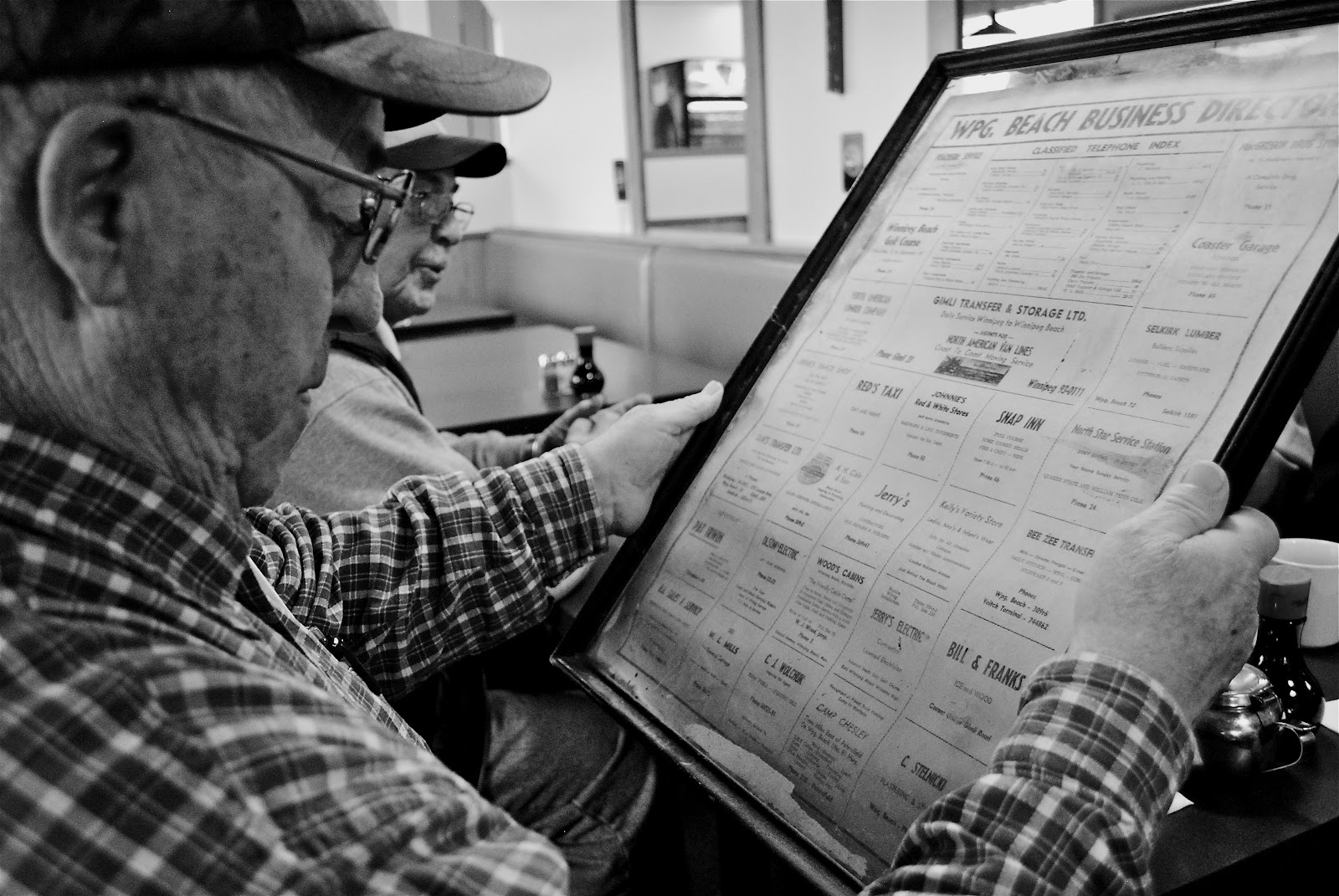
Instead, I sat at the local Chinese restaurant with a group of men today, all locals, chatting over luke warm cups of coffee about the old days of Winnipeg Beach. A travel assignment brought me here with Tammy and Suzy, two of my favourite classmates - and people in general, for that matter.

As we sat, our new friends urged each other to start telling stories. The guys wanted to hear John tell the one about the big fish, but he decided to save it for another time. Instead, he told me about how, back in the day, they used to cut slabs of ice out of the lake, haul them with horses and ship them off to Winnipeg. You know, when people used ice boxes as freezers? John used to be Winnipeg Beach and Gimli's milkman.

The group continued to banter back and forth, until Allan, one of our new friends, offered to 'just run home quickly to show you guys the old phone directory'. The sweet charm of small towns never fails to warm my heart.

Our server, Geri, who also happens to own the motel in town, also offered to 'just run home quick, and get you guys the CBC dvd special they did about Winnipeg Beach'. Again. My heart melts. I've known Geri and Allan for maybe 25 minutes and they both offer to run home and bring something that will surely help our trio with our travel assignment. I mean, honestly. That kind of thing just wouldn't happen in the city.

Thanks so so much to our new friends at Winnipeg Beach for being so warm and sharing your stories with us. John, I still want to hear about that big fish and Geri - Tammy, Suzy and I are looking forward to a girls weekend at the lake, so save us a room in July!